
How to Search Civil Dockets
Want a free look at a public Oneida County civil docket? Begin at Wisconsin Circuit Court Access. Pick Oneida County and type in a party or business name. Common names may need a first name, middle name, suffix, or date of birth. That separates similar hits. Running the query statewide also turns up civil cases filed elsewhere in Wisconsin.
A full case number is the fastest path when you have it. WCCA's advanced fields cover case type, status, filing and disposition dates, class code, attorney, and State Bar ID. General civil matters carry CV numbers. Small claims use SC. Liens, foreign judgments, family cases, probate, and other case families each get their own label.
- Open WCCA and select Oneida County.
- Enter the party name, business name, or full case number.
- Compare the caption, filing date, case type, status, and county.
- Open the matching summary and review filings, events, and disposition.
- Ask the clerk for the actual public filing or certified judgment.
The Clerk of Circuit Court can also help directly. Reach the office by phone at 715-369-6120, by mail at P.O. Box 400, Rhinelander, WI 54501, or at the third-floor counter at 1 S. Oneida Avenue. A courthouse WCCA terminal may allow public review of in-county information and documents. The county posts no civil copy-request form. So call first with the case number, the exact document, its date, and the copy type you want.
Oneida Civil Docket Labels
Every Wisconsin case number opens with a code that shows which case family holds the record. A general civil number looks like 2026CV000045. A small-claims number looks like 2026SC000012. Both are format examples only, not real matters.
- CV
- General civil cases, including many large claims.
- SC
- Small claims, including money claims within the stated limit, evictions, and replevins.
- FA
- Family cases, which can carry added privacy limits.
- TJ
- A transcript of judgment entered in the court system.
- Satisfaction
- A filed record that the judgment creditor acknowledges the judgment has been met.
A docketed judgment is not automatically a satisfied one. Read status entries and filing entries side by side to see where a matter truly stands. WCCA reflects data from CCAP, yet the official judgment and lien docket stays with the clerk.
What a Civil Docket Shows
A public summary of an Oneida County civil docket can list the case number, filing date, county, caption, parties, status, court events, and disposition. Entries may show a complaint, answer, motion, hearing, order, judgment, or satisfaction. But an entry's title only names the document; it does not reproduce what is inside.
| Case number | Year, case type, and six-digit sequence. |
|---|---|
| Parties | Plaintiff, defendant, or other public party roles. |
| Filings | Dated entries for pleadings, proof of service, motions, and orders. |
| Settings | Scheduling conferences, motion hearings, pretrial events, and trials. |
| Judgment | The recorded ruling, dismissal, or money judgment, as public. |
Think of WCCA as a public summary rather than a full online document store. It helps you find a filing, but the complaint, exhibits, proof of service, or signed judgment may not appear there. For those, ask the clerk to inspect or copy the public file.
Oneida Large and Small Claims
The Oneida County civil division spells out what counts as a large claim: personal injury, wrongful death, property damage, foreclosure, money claims over $10,000, name changes, and restraining orders. That official page also defines the basic building blocks of a civil case, including summons, complaint, answer, counterclaim, scheduling conference, final pretrial, motion, trial, and judgment.
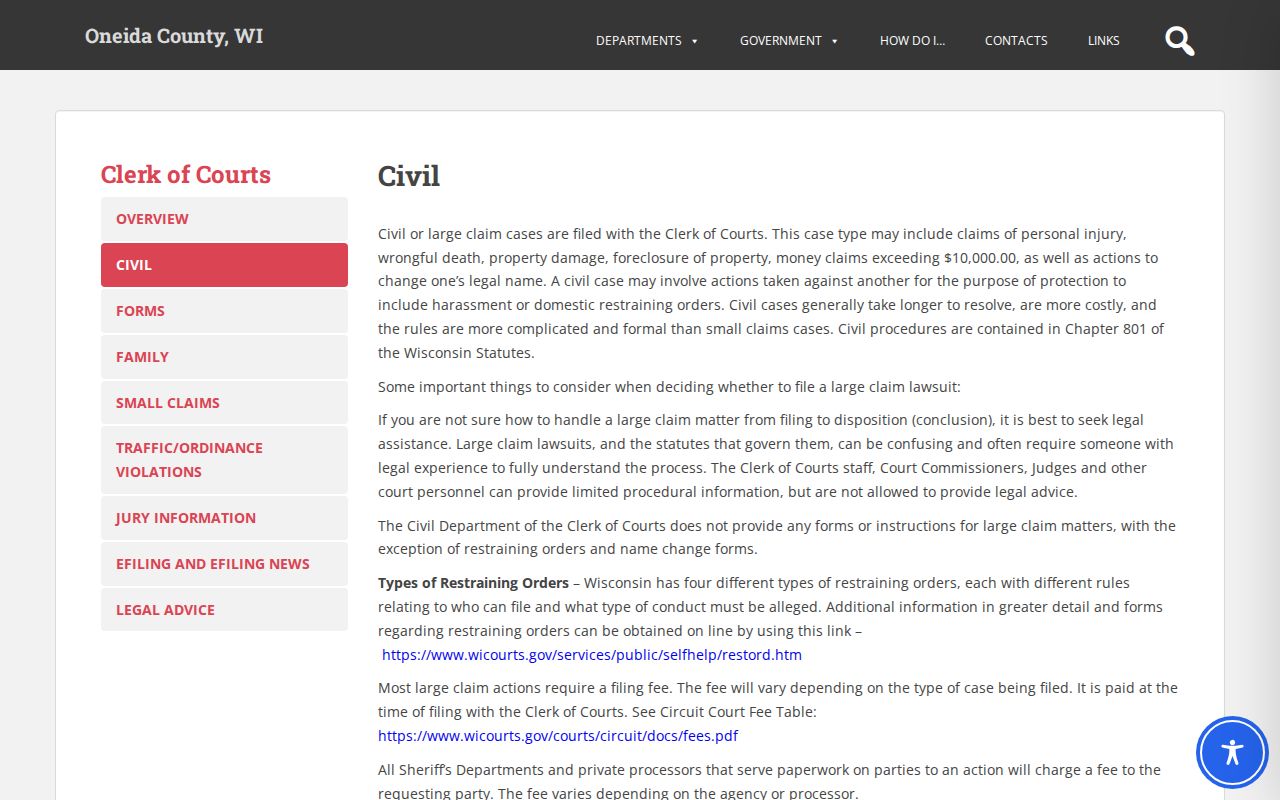
That official page mirrors how Oneida County actually handles civil filings. A large claim moves through the general civil route. The exact case type and public access still depend on what was filed. Clerk staff will explain procedure and hand out forms. What they cannot do is pick your legal theory or draft the claim for you.
| Track | Oneida examples | WCCA clue |
|---|---|---|
| Large civil | Personal injury, foreclosure, property damage, money claims over $10,000 | Often CV |
| Small claims | Claims at or below $10,000, evictions, replevins | SC |
| Other civil families | Family, liens, foreign judgments, name changes, restraining orders | Case-specific code |
Types of Civil Cases on the Docket
Money disputes are only part of the Oneida County civil docket. The case code and caption help you tell one proceeding from another, while the underlying filing states the actual legal request. Access to a given case or document may vary.
- Personal injury, wrongful death, and property damage claims.
- Foreclosure and money claims above the small-claims threshold.
- Small money claims, evictions, and replevin actions for return of property.
- Name changes, restraining orders, liens, and foreign judgments.
- Family proceedings and other civil case families when public.
Probate, guardianship, adoption, commitment, and juvenile records follow specialized routes and can be confidential. For those matters, the Register in Probate or the juvenile clerk may hold the record instead of the ordinary public civil counter.
Oneida Small Claims Deadlines
The official Oneida small-claims page covers claims at or below $10,000, plus evictions and replevins under Chapter 799. It notes that the clerk assigns dates once a claim is filed. Evictions move on a tighter clock than an ordinary money claim.
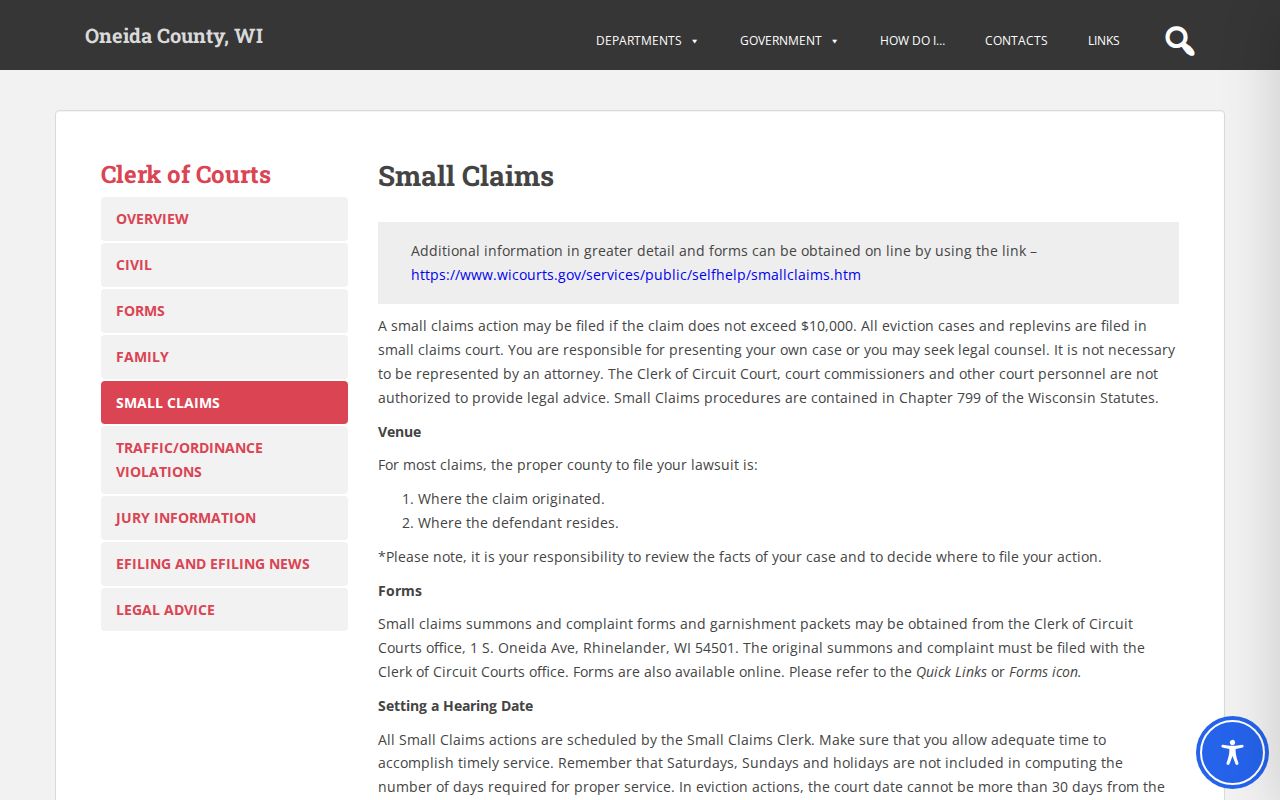
Oneida County's own instructions connect the public docket to real deadlines. For evictions, the county states that the return or trial falls within 30 days of issuance and that service must happen at least five days before the return date. Other small claims generally need at least eight days. Statutes, court instructions, and exceptions control, so verify each deadline before you act on it.
Missing a setting can end in dismissal or default judgment, depending on who failed to appear and the type of claim. After judgment, the docket may show notice of entry, financial disclosure, garnishment, a writ, reopening activity, or docketing of the judgment itself. Each entry carries its own effect.
Settings and Hearings on Civil Dockets
Civil settings in Oneida County take several forms. A scheduling conference, a motion hearing, a final pretrial, a trial, or a judgment hearing may all appear on the docket. WCCA's calendar tools let you filter by county, court office, and date range. That helps a lot here. Branch I and Branch II sit in the same Oneida County courthouse. So knowing the branch or court office tells you where a setting belongs.
A setting is simply a scheduled court event, and it is not always the trial date. A continuance pushes an event to a new day. A scheduling order can lay out several future steps at once. Read the latest docket entry right before the hearing. If the display is unclear, call the clerk or the assigned branch. The Clerk handles record questions, Branch I is 715-369-6157, and Branch II is 715-369-6200. Keep one thing straight about the calendar: an entry confirms a listed setting, not the final outcome of the civil case.
Oneida Civil Judgment Satisfaction
Two Oneida County filings get confused for each other. A judgment records what the court ordered, while a satisfaction records the judgment creditor's acknowledgment that the judgment has been met. The Oneida civil page spells out the process: the creditor signs the satisfaction, has it notarized, and files it with the clerk along with a $5 satisfaction fee.
Check both records: A WCCA status or judgment entry does not replace the filed judgment, the official judgment and lien docket, or a later satisfaction.
Docketing a judgment, transcript, lien, or warrant also carries a $5 charge under the current state fee chart. Fees do change, so rely on the live chart and confirm with the clerk before sending payment. When you need something for formal use, request the correct record type rather than a screen print.
Oneida Civil Docket Copies
A precise request moves faster through the clerk's office. Include the county, the case number and type, the full caption, the exact document and its filing date. Also say whether you want inspection, a plain copy, or a certified copy. The current 2026 state chart puts clerk regular copies at $1.25 per page. Certified copies add a $5 certification charge on top of the $1.25 per page.
Local Rule 1 keeps access to court files inside the clerk's office. It bars removing files without judicial approval. It has the clerk supply copies for a reasonable fee, sealed documents excepted. Under Local Rule 2, the clerk takes no filings by fax or email. Remember that a records request and a filing are different acts with different rules.
Authorized parties and attorneys may reach more documents through Wisconsin Circuit Court eFiling. The view differs by route. Public WCCA, authenticated eFiling, Courthouse WCCA, counter inspection, phone, and mail do not all show the same material.
Public Access to Civil Dockets
Access to Oneida County civil dockets is case- and document-specific. Wisconsin's public-record policy does not sweep aside confidential filing rules, protected identifiers, or a judge's sealing order. Family financial data, protected addresses, medical material, guardianship and commitment records, and documents concerning children may be limited or withheld.
Access rules:
Wis. Stat. § 19.31 states Wisconsin's public-record policy.
Wis. Stat. § 801.19 protects specified personal information in court files.
Wis. Stat. § 801.21 governs sealing and redaction requests.
A blank WCCA search can mean many things. It may reflect a spelling error, the wrong county, a conversion limit, a display rule, confidentiality, or just recent processing. It does not prove that no civil matter exists. Ask the clerk for the lawful route to the official file, and never put a full protected identifier into a search or request.