
How to Search Criminal Dockets
Begin at Wisconsin Circuit Court Access, the public system most people call WCCA. It opens a window onto circuit court case summaries and calendars statewide. Pick Oneida County to keep the results local. Name searches can take a last or required name, first and middle names, a suffix, a business name, or a date of birth when similar names need sorting apart. Filed somewhere else in Wisconsin? Search statewide instead.
A case number beats everything as a search key. Advanced fields let you filter by filing date, disposition date, status, case type, citation number, District Attorney number, offense date, issuing agency, attorney type, and State Bar ID. Those controls can shift, so check the current help text before relying on them.
- Open WCCA and accept its public access terms.
- Select Oneida County, then enter the full name or case number.
- Compare county, type, filing date, caption, and identifying fields.
- Open the match and note its branch, status, events, and next setting.
- Ask the clerk for any filing, transcript, or certified copy needed.
The screen is not the only route. The Oneida County Clerk of Circuit Court takes questions by phone at 715-369-6120. Reach the office by mail at P.O. Box 400, Rhinelander, WI 54501. You can also visit the third-floor counter at 1 S. Oneida Avenue. CCAP materials also describe Courthouse WCCA access to public in-county information and documents. Ask the clerk where that terminal sits.
Oneida Criminal Docket Codes
Every Wisconsin case number pairs a four-digit year with a two-letter type code and a six-digit sequence. Consider 2026CF000123, a felony example, or 2026CM000031 for a misdemeanor. WCCA pads short sequences with leading zeros.
- CF
- Felony circuit case.
- CM
- Misdemeanor circuit case.
- CT
- Criminal traffic matter.
- Pending
- The case remains open. It does not state guilt.
- Disposed
- An ending event was recorded. It does not always mean conviction.
Criminal cases are not the only codes you will meet. Chapter 968 or 979 proceedings and forfeitures may be grouped apart from criminal work in workload reports. So read the individual docket entries before judging a case by its code alone.
That number also threads every channel together. Hand it to the clerk for a copy request. Use it to narrow the calendar. Give it to the assigned branch when asking about a hearing. No case number? Pair a full name with an approximate filing year and the likely case type. That keeps the inquiry pinned to one record and prevents mix-ups between similar names.
What a Criminal Docket Shows
A public Oneida County criminal docket may list the case number, filing date, county, caption, parties, status, charge information, court events, and disposition data open to public display. A financial view can add a balance or a due date. These fields help you locate and track the case. They are not the complete file.
| Case number | Year, criminal type code, and sequence. |
|---|---|
| Charges | Filed offense descriptions and related public data. |
| Court events | Hearings, motions, pleas, trial activity, and sentencing settings. |
| Status | Whether the case is pending or has a recorded disposition. |
| Disposition | The recorded result, which must be read in context. |
WCCA refreshes its data hourly, with nightly maintenance running roughly 3:00 to 4:00 a.m. Central. Fresh filings may lag behind. Detail thins out on older cases too, since counties adopted CCAP and converted old records at different times.
Oneida Criminal Docket Volume
For scale, turn to the 2024 Wisconsin county clearance report. It is not a live count. Its Oneida criminal aggregate spans felony, misdemeanor, criminal traffic, traffic forfeiture, Chapter 968 and 979 proceedings, and other forfeitures. The report lists 1,174 incoming matters and 1,109 disposed. Another 129 were pending at year-end. The clearance rate was 98 percent.
A District Attorney budget snapshot counted different work entirely: 778 actively pending or filed cases, 263 cases with victims, 53 under review, and about 831 active cases. Keep the two sources apart.
Note: A clearance rate compares incoming and disposed workload; it is not a conviction rate.
Stages on a Criminal Docket
A filing opens the case. The arraignment entry records the plea process. Pretrial settings may handle motions, scheduling, or resolution, and trial events follow when needed. The disposition entry shows how a charge or case ended, and sentencing may appear separately.
Docket flow: Filing › Arraignment › Pretrial › Plea or Trial › Disposition › Sentencing
Few Oneida County criminal cases travel a straight line. Hearing settings move, motions can land between stages, and separate charges may end differently. Pending is not a finding of guilt. Labels like transferred or deactivated in the statistics say nothing about conviction either.
Oneida Criminal Docket Branches
Two Circuit Court branches operate in the same Rhinelander courthouse. They share one Clerk of Circuit Court record system. Branch assignment still matters for hearings, courtroom questions, and transcript requests.
| Office | Role | Phone |
|---|---|---|
| Clerk | Official file, inspection, copies | 715-369-6120 |
| Branch I | Assigned events and reporter route | 715-369-6157 |
| Branch II | Assigned events and reporter route | 715-369-6200 |
Route docket copies and general questions to the clerk. Take courtroom or judge-office matters to the branch. And remember, a calendar listing is not proof of final disposition.
Which Court Holds Criminal Dockets
Felony and misdemeanor cases belong to Wisconsin Circuit Court. The Oneida County Clerk keeps the official record for both branches. A local ordinance matter can reach circuit court when a municipality has no municipal court of its own. That does not make every ordinance case criminal. The state directory lists no Rhinelander municipal court.
Federal prosecutions go to the U.S. District Court for the Western District of Wisconsin. WCCA does not cover that court. A state appeal moves to the Wisconsin Court of Appeals. Oneida sits in District III. The trial summary will not show the full appellate docket.
Missing Oneida Criminal Cases
A blank result does not prove that no case exists. Check the spelling, any suffix, date-of-birth filters, county, and case type before giving up. If the location is uncertain, run a statewide search instead. A fresh filing may still be processing. An older converted case may carry little detail.
Privacy can also explain a thin result. WCCA does not display every record or document. Call the clerk with the party name, the likely year, and the case type. Staff can explain access, though they cannot give legal advice or bypass a seal.
Best next step: Find the case number in WCCA, then ask for the exact public filing, copy, transcript, or inspection needed.
Oneida Criminal Justice Coordination
The Oneida County Criminal Justice Coordinating Council publishes material on local justice coordination and diversion work. County meeting listings also name a Criminal Justice Coordinating Committee along with an OWI Court Sub-Committee.
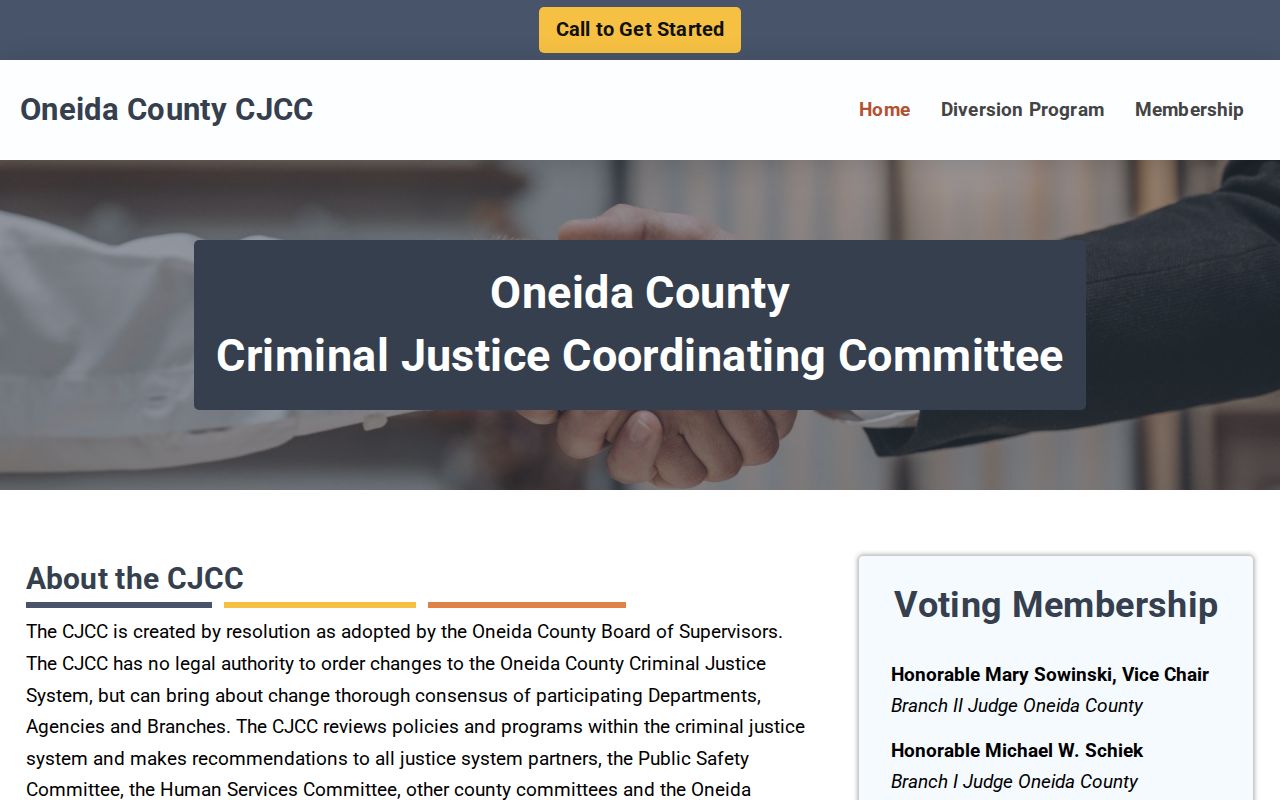
That official source gives useful local context. It does not prove a separate public treatment-court database exists. No complete named specialty docket appears there. Individual cases still start with WCCA and the clerk.
A program meeting and a Oneida County criminal docket entry answer very different questions. Meeting material may lay out coordination goals, public policy, or agency work. The court docket records what happened in one specific filed case. Neither one supports the other's conclusions. A committee agenda cannot show that a person entered a program. The committee also has no control over a judge's case decisions. When a public case summary lists an event you do not recognize, use the case number and the event date. Ask the Clerk which public filing explains it. That keeps your inquiry anchored to the official Oneida County criminal record.
Public Access and Sealed Criminal Dockets
Wisconsin leans toward open records. Criminal court access is still case- and document-specific, though. Oneida Local Rule 1 keeps files under authorized control, limits access to the clerk's office, bars removal without judicial approval, and permits copies for reasonable fees except for sealed material in a Oneida County court docket.
Key rules:
Wis. Stat. § 801.19 protects personal identifiers.
Wis. Stat. § 801.20 governs confidential filings.
Wis. Stat. § 801.21 provides sealing and redaction procedure.
Some data is protected by law. Think Social Security numbers, account numbers, passwords, license numbers, state ID numbers, and passport numbers. Victim or witness data may also be withheld from a Oneida County court docket. So may presentence reports and sealed filings. The clerk cannot lift or create a seal.
Statewide WCCA, Courthouse WCCA, the counter, the phone, and the mail are five distinct channels. Each one offers different material, so do not treat them as equal.
Transcripts and audio follow a separate route entirely. A docket can identify the hearing date and the branch. It is not a transcript. Ask the clerk or the court reporter about the current process and the cost. Each branch has its own reporter contact, and assignments can change. Give staff the case number, the hearing date, and the proceeding. That way they can route the request correctly.
Before relying on any event or status, compare the current Oneida County criminal docket against the official file as a final check.